“But to date no pick has been able to provide guitarists with any data about their playing. Pickatto hopes to change that.”
Validation
The idea has already been tested in public.
Pickatto was demonstrated on the largest stage its industry has, covered by the titles that industry reads, and put in the hands of working guitar instructors. The reaction is on record — which removes a question a buyer would otherwise have to answer with research.
The show floor
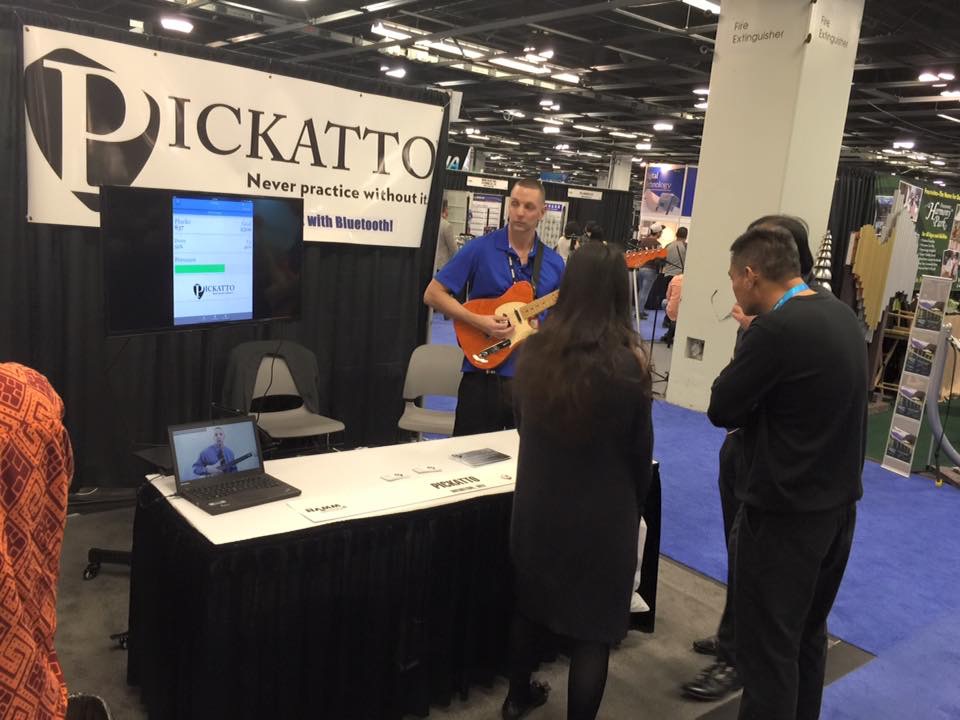
NAMM 2016, Anaheim
The first working prototype was demonstrated from a Pickatto booth at the NAMM show in Anaheim — the largest music products convention in the world, and where the buyers, distributors and press of this industry are in one building.
It is also where the category question got answered. Visitors did not need the premise explained to them: every guitarist who picked it up understood immediately what measuring the picking hand would tell them, which is not true of most new accessories on that floor.
The new age of learning any instrument is trending toward “quantified musician” technology to make practice time more efficient and goal oriented; Pickatto is right in line with this way of thinking.
Coverage
What the trade press said
Covered on the strength of a prototype, by outlets with no reason to be generous about a new plectrum.
“Countless picks come through these hallowed doors — some are designed as learning aids, others claim to revolutionise the plectrum, but the Bluetooth-enabled Pickatto aims to do both.”
“Many incredible inventions were featured throughout the convention but the most innovative was the Pickatto.”
“The software is really accurate.”
“A measure of music”
Links are to the original publications and are preserved as they were filed in 2016. Some outlets have since reorganised their archives; copies of every piece are held in the data room.
In the hands of players
Guitarists, not focus groups.
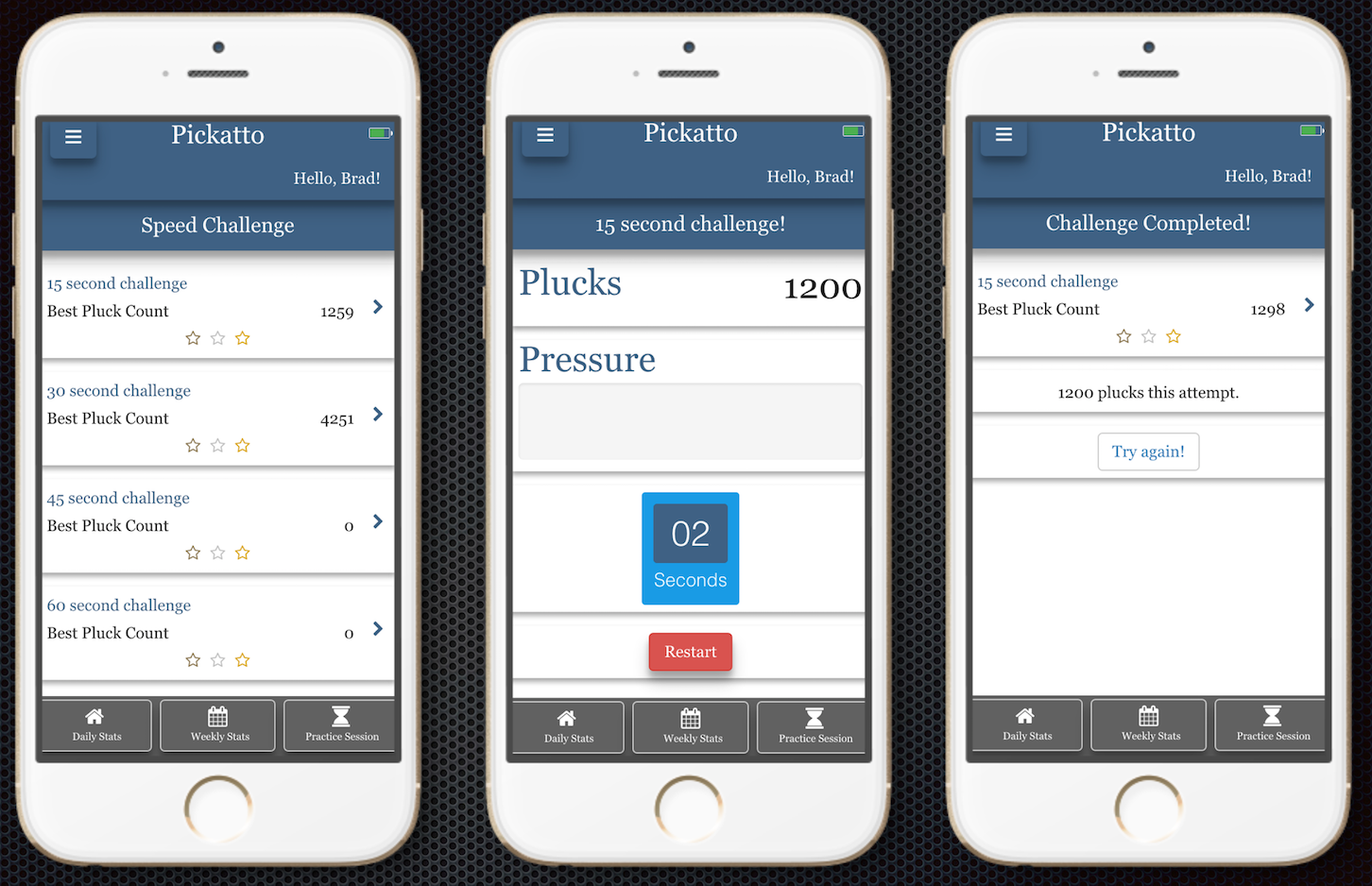
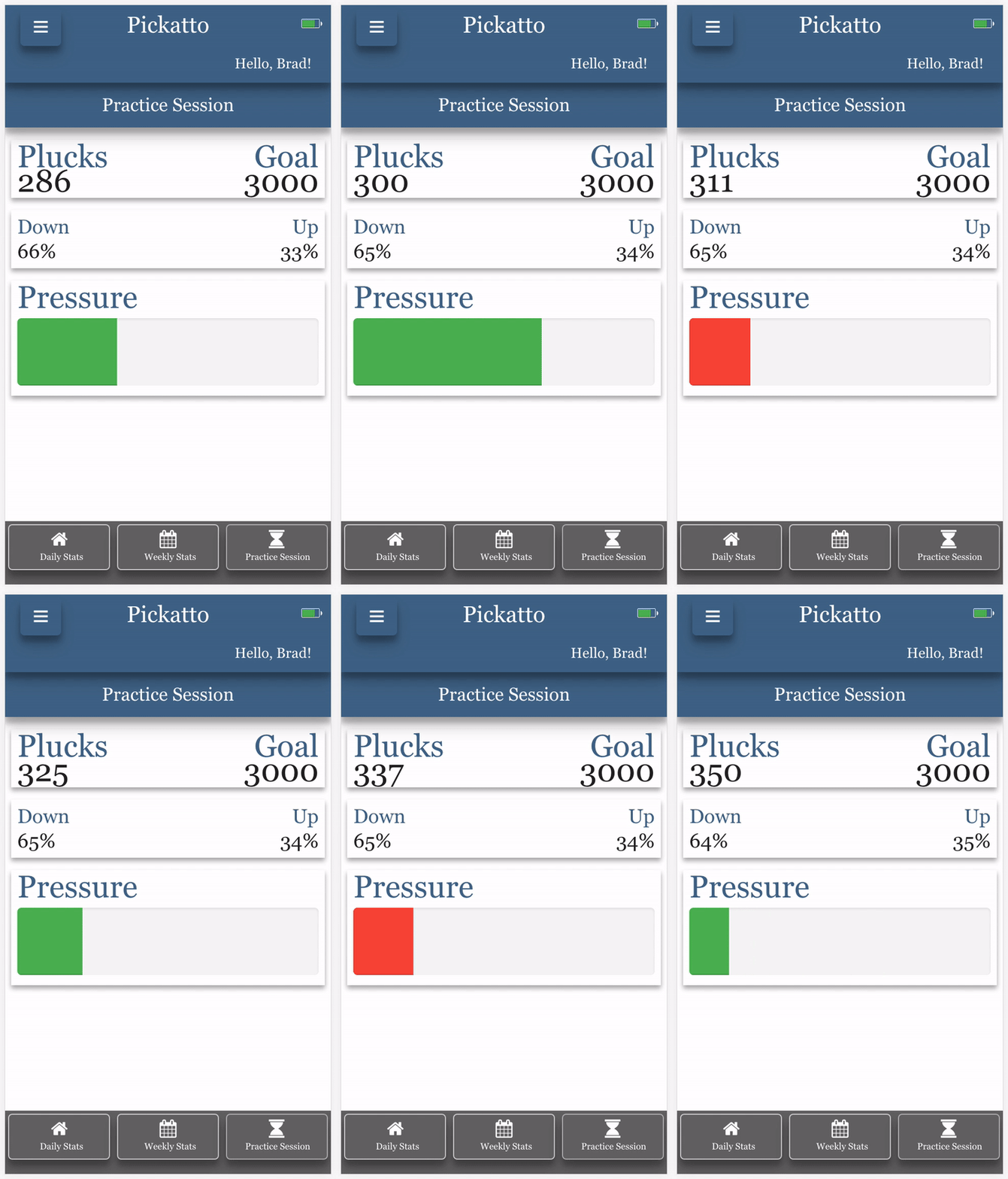
Prototypes went to working instructors and players, and the feature set changed because of what they said. The Speed Challenge exists because guitarists who tried the pick asked for it — and it refuses to score a run once the grip tenses, which is the whole thesis of the product expressed as a game.
Silo Ornelas, a guitar instructor from Bakersfield, California, and the first featured Pickatto player, demonstrating the pick and the companion software.
The record
From idea to proven firmware.
Two kinds of validation sit on this timeline. The first half is the market saying yes; the second is the engineering being made genuinely solid, which is the half that determines whether a buyer can ship it.
- May 2015
The idea
A guitarist of twenty-five years asking why every practice tool measures the fretting hand.
- June 2015
Patent application filed
The instrumented plectrum — sensing at the pick and reporting wirelessly.
- October 2015
First working prototype
Sensing, radio and a companion application, end to end on real hardware.
- November 2015
Unveiled publicly
- January 2016
NAMM, Anaheim
Demonstrated from the company’s own booth at the largest music products convention in the world, and covered by the guitar trade press off the back of it.
- May 2016
Crowdfunding campaign
Taken to market directly, with fulfilment to backers later that year.
- 2016 onward
Hardware through four revisions
Rev 2, 3.1, 3.2 and 3.3, each fabricated and brought up, with the schematics and the reason for every change retained. Rev 3.3 is the board that exists today.
- Through 2025
C firmware fielded and updated over the air
Sealed units running in the field, receiving signed updates — the version history recorded by hand, because a sealed unit cannot be interrogated any other way.
- August 2026
Rust rewrite reaches parity, verified on hardware
A complete reimplementation matched the C firmware feature for feature and was confirmed on a board — including a live over-the-air update that replaced the old firmware with the new one. That is the hardest thing to prove about an embedded product, and it is proven.
- September 2026
Bootloader extracted and made reproducible
The one component an update cannot repair was moved off a 141-second legacy toolchain onto a 1.3-second one, with byte-identical output as the acceptance test.
- Late 2026
Faults root-caused and written up
A power fault reasoned about from convention for three revisions was settled by reading the part’s own datasheet, and two bench boards were each diagnosed to a specific physical defect. Those write-ups transfer with the asset.
Company and marketEngineering
Acquisition & licensing
The whole package is available for review.
Patent, schematics, BOM, fabrication outputs, the firmware and the bench tooling — under NDA, with an engineer available to walk through any of it.